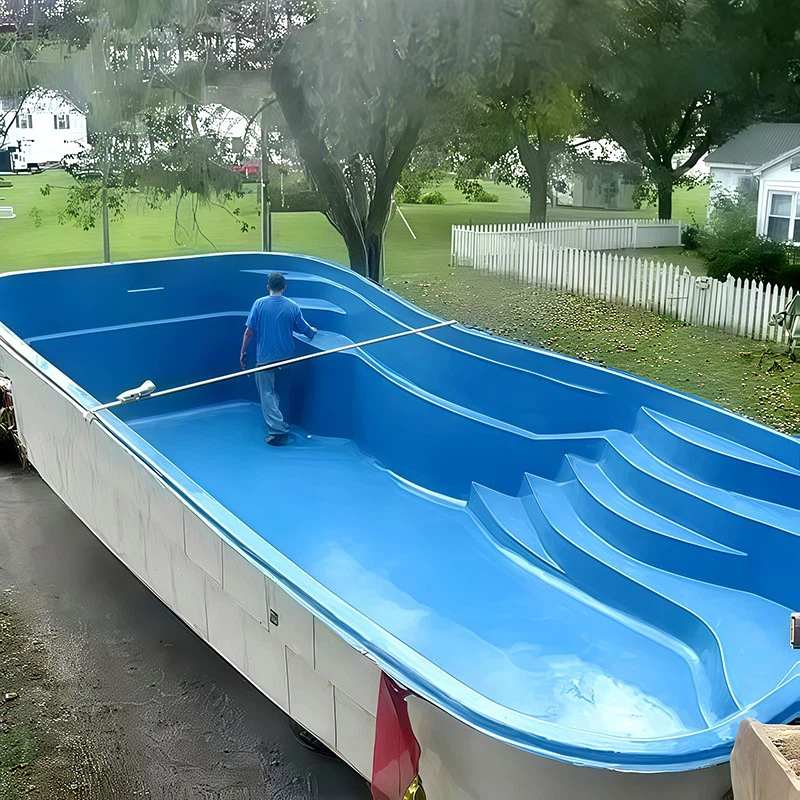
Much like plaster or vinyl pools, the surfaces of fiberglass pools are susceptible to the effects of aggressive water chemistry. Over time, excessive chlorine levels or low pH values can cause the fiberglass gelcoat on the pool to fade. However, fiberglass pool surfaces typically do not erode in the same way that plaster does, nor do they develop punctures like vinyl liners. A properly maintained fiberglass swimming pool can last a lifetime. Here are some tips for keeping yours clean and bright.
1. Pool Walls
Household cleaners-or other non-abrasive commercial cleaners designed for tiles or vinyl-can easily remove the "bathtub ring" that forms on pool walls or tiles due to body oils, sunscreen, and airborne contaminants. Do *not* use abrasive cleaners, steel wool, metal scrapers, stiff brushes, or sharp tools, as these may permanently damage the gelcoat surface. Dull gelcoat areas located above the waterline can be restored using a heavy-cut automotive polish (applied either by hand or with a power buffer), followed by an application of wax. For a high-gloss finish, we recommend using Gel-Gloss.
The gelcoat surface of a fiberglass pool can be scratched, just like any other glossy surface. However, the gelcoat is seven to eight times thicker than a standard paint finish, so it is highly unlikely that a scratch would penetrate beyond this surface layer. It is not uncommon for hairline cracks to appear over time; these typically only penetrate the gelcoat layer and do not compromise the pool's structural integrity or cause leaks. Scratches and hairline cracks can be repaired using a gelcoat repair kit.
Most dirt and debris that settle to the bottom of the pool can be brushed toward the main drain, where it will be captured by the filtration system. Large accumulations of dirt and debris should be removed manually.
Vitamin C (ascorbic acid) can be used to treat severe brown staining-yes, it sounds unusual, but it works! You can purchase it at most pool supply stores, or buy it in pill form at a health food store (you will need a large bottle); simply place the pills into the skimmer basket. As it reacts with the stains, it may cause your pool water to become cloudy for 2–3 days. Once the stains have disappeared (typically after about 48 hours), you will need to re-balance the pH levels of your now stain-free pool water.
2. Fiberglass for Swimming Pools
Fiberglass gel coating can be used to resurface a pool or to convert the vinyl liner in an in-ground pool into a more permanent, robust in-ground structure. In southern regions-particularly in Florida-this fiberglass application has been extremely popular for years; now, pool contractors nationwide are increasingly adopting fiberglass as a preferred material.
Fiberglassing a swimming pool costs roughly the same as applying a standard replastering finish, and most companies offer warranties of up to ten years on the gel coat. Fiberglass provides a strong, durable finish derived from a three-component coating system, and it is available in a wide variety of colors.
Fiberglass is applied using a "chop gun"-a versatile spray gun featuring three ports: one for the catalyst (i.e., the hardener), one for the resin, and one for compressed air that feeds the fiberglass strands into a chopper mechanism (which cuts the strands into 1-inch pieces). The chopper consists of a wheel fitted with spaced blades, ensuring the strands are cut uniformly and propelled by the airflow. During application, all these components mix together in mid-air as they are sprayed onto the pool surface.
3. Converting In-Ground Vinyl-Lined Pools to Fiberglass
Fiberglass is an excellent self-supporting material that does not require additional structural materials for reinforcement. This is precisely why it can be used to convert existing in-ground vinyl-lined pools.
4. Here is the complete process:
Cut and remove the vinyl liner, then remove all return flanges and skimmer faceplates.
Next comes the taping and masking stage: all coping, return inlets, main drains, and the surrounding pool deck are taped off and covered to prevent overspray (care must also be taken to protect nearby vegetation).
Once a color has been selected, the appropriate pigment is added to the resin component of the mixture to create the desired hue.
Now it is time to apply a quick spray of catalyst-solely to prime the surface of the pool shell-followed by the application of the first coat using the complete "fiberglass coating" mixture (comprising the catalyst, resin, and fiberglass strands).
This three-part mixture is applied in sections, covering a maximum area of approximately one square foot per pound of material (typically applied in 6x6-foot sections at a time). After spraying this section, use a paint roller to flatten it down, thereby smoothing out any protruding strands; failure to do so could cause these strands to harden into sharp points-much like nails or spikes (and ouch-you certainly wouldn't want those at the bottom of your pool!). Next, use a paintbrush to "tuck" the fiberglass material into the crevices beneath the tiles and around the return inlets.
Allow this first coat to cure for 24 hours. Once dry, the surface will appear rough, as the individual fiberglass strands will be exposed. After the initial coat has fully cured, sand the surface using coarse-grit sandpaper. This step serves to knock down and smooth out any sharp points or spikes that may not have settled flat during application. At this stage, use a sharp utility knife to trim away any excess coating around the tile line, as well as around the return inlets and drain outlets.
You are now ready to apply the final coat; however, this application utilizes only two components. For this step, spray the pool using only the catalyst and resin mixture to achieve a smooth, glossy finish-this is known as the "gel coat" (this layer is *not* rolled). Allow the gel coat to cure for 48 hours, then remove the skimmer faceplate and all masking tape using a utility knife.
Finally, position the skimmer faceplate frame and return inlet flanges back into place, and use a utility knife to pierce through the fiberglass lining to create openings for the mounting screws (always use new gaskets on all return inlets and skimmers to prevent leaks).