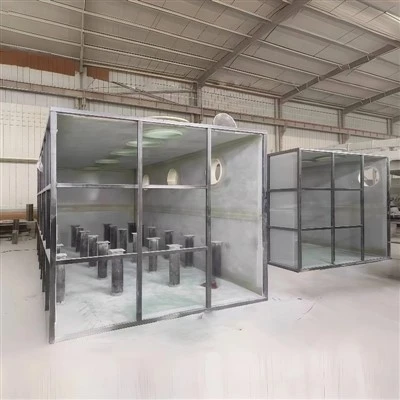
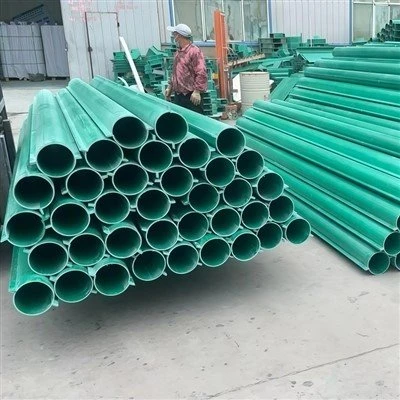
Product Overview
Industrial FRP (Fiber-Reinforced Plastic) environmental equipment is engineered for industrial air pollution control, exhaust gas treatment, and odor control systems operating in corrosive chemical and high-humidity environments.
Our manufacturing range comprises wet scrubbers, absorption towers, biofilter housings, and corrosion-resistant FRP ductwork. Equipment configuration and material selection depend on process gas composition, chemical concentrations, operating temperature, moisture content, pressure conditions, and installation requirements.
Each project is evaluated according to its specific operating conditions and applicable design requirements. Custom configurations incorporate process connections, access openings, internal packing supports, structural reinforcement, and other project-specific features.
-
![FRP Wound Septic Tank]() FRP Wound Septic TankOur FRP Wound Septic Tanks adopt advanced winding technology and internal integrated partitions, ensuring excellent structural integrity. Stringently tested for leakage and purification performance,
-
![Grp Septic Tank]() Grp Septic TankOur grp septic tanks are professionally molded with optimized internal flow channels and partitions for efficient sewage treatment. Each tank is leak-tested and purification-tested for reliability;
-
![Integrated Prefabricated Pumping Station]() Integrated Prefabricated Pumping StationOur Integrated prefabricated pumping station has a strong fiberglass tank with all core equipment pre-assembled in the factory. Each unit is fully tested before delivery, customizable to flow and
-
![FRP Desulfurization Tower]() FRP Desulfurization TowerOur FRP Desulfurization Towers are made of high-temperature and corrosion-resistant FRP, equipped with spray, packing and demisting systems. All units are strictly tested for purification efficiency,
-
![FRP Type Cooling Tower]() FRP Type Cooling TowerOur frp type cooling towers are assembled with molded FRP panels and built-in fillers, spray systems and fans, all products pass cooling efficiency and air tightness tests before delivery. The
-
![Cooling Tower Filler]() Cooling Tower FillerOur cooling tower filler is available in FRP and PVC options with customized waveforms and sizes, and the FRP type is manufactured with molding or pultrusion process. All products pass heat transfer


Key Features
Application-Based Resin Selection: Resin systems include verified vinyl ester, epoxy, or polyester grades, matched to chemical compatibility, operating temperatures, and specific environmental exposure profiles.
Corrosion Barrier Design: A dedicated resin-rich inner layer and suitable surface reinforcement are incorporated into the laminate design to protect structural glass layers from the process medium.
Flexible Manufacturing Methods: CNC filament winding and hand lay-up or contact molding are selected according to equipment geometry, dimensional limits, and structural load requirements.
Project-Specific Connections: Nozzles, flanges, manways, internal supports, and external reinforcements are configured according to approved design drawings and interface requirements.
Engineering & Documentation Support: Design submittals, inspection records, and project documentation packages are structured to align with project contractual standards.
Technical Specifications
|
Parameter |
Selection or Design Basis |
Confirmation Required |
|
Equipment Type |
Wet scrubbers, absorption towers, biofilter housings, FRP ductwork |
Process function and equipment configuration |
|
Diameter Range |
Standard fabrication capabilities up to 4.2 meters diameter |
Required dimensions and manufacturing limits |
|
Operating Conditions |
Temperature, pressure/vacuum, humidity, and flow rate |
Normal, maximum, and abnormal operating conditions |
|
Chemical Exposure |
Gas composition, chemical concentrations, condensate, and cleaning agents |
Complete chemical and operating profile |
|
Resin System |
Vinyl ester, epoxy, or suitable polyester resin, where applicable |
Chemical compatibility and temperature requirements |
|
Laminate Construction |
Surface layer, corrosion barrier, structural laminate, and optional UV shield |
Approved laminate specification and design requirements |
|
Connections |
Nozzles, flanges, manways, and other interfaces |
Connection dimensions, mating equipment, and loading conditions |
|
External Loads |
Wind, seismic, piping, support, and lifting loads where applicable |
Project design criteria and load data |
|
Inspection & Testing |
Dimensional check, visual examination, hardness testing, or leak testing |
Inspection plan and acceptance criteria |
|
Applicable Standards |
Standards selected for specific equipment and project (e.g., ASTM D3299, ASTM D4097) |
Required design, fabrication, and documentation provisions |
Manufacturing Capabilities
Manufacturing methods are selected according to equipment design, geometry, laminate requirements, and approved production procedures:
CNC Filament Winding: Utilized for applicable cylindrical shells and vessels up to 4.2 meters in diameter and 15 meters in length, ensuring uniform hoop-to-axial stress distribution.
Hand Lay-Up and Contact Molding: Deployed for complex shapes, non-cylindrical housings, internal baffles, and local structural reinforcements.
Corrosion Barrier Fabrication: Surface reinforcement and resin-rich layers are constructed according to the intended chemical exposure and approved laminate design.
Curing and Post-Curing: Thermal curing schedules are determined by the selected resin system, manufacturer recommendations, and approved production procedures.
Tooling and Molds: Steel and composite mandrels are adjusted according to required equipment geometry and dimensional tolerances.

Quality Control
Quality control procedures are defined according to equipment design, approved drawings, manufacturing procedures, and project acceptance criteria:
Raw Material Verification
Resin and reinforcement materials are checked against purchasing and material requirements, with supplier certificates reviewed.
Process Control
Relevant manufacturing parameters and curing records are documented in accordance with production procedures.
Hardness Testing
Barcol hardness testing is performed in accordance with ASTM D2583, evaluated against the resin manufacturer's requirements.
Visual and Dimensional Inspection
Accessible surfaces, overall dimensions, wall thickness, nozzle locations, and connection details are inspected against approved shop drawings.
Leak or Pressure Testing
Performed where applicable to equipment design using agreed test procedures and acceptance criteria.
Traceability and Documentation
Material records, inspection reports, and quality documents are compiled into a final data package before dispatch.
Applications
FRP environmental equipment is deployed across industrial processes involving corrosive exhaust gases, humid air streams, and odor-control duties, subject to application-specific engineering review:
Municipal Wastewater Treatment: Odor-control systems and exhaust treatment equipment handling hydrogen sulfide (H2S) and ammonia (NH3).
Chemical Processing: Scrubbers, absorption towers, and ventilation ductwork exposed to defined chemical process streams.
Industrial Manufacturing: Exhaust collection and treatment systems exposed to chemical fumes, moisture, or process-specific contaminants.
Pulp and Paper: Selected exhaust treatment and ventilation applications subject to chemical compatibility reviews.
Electronics and Semiconductor Facilities: Corrosive exhaust systems evaluated after reviewing specific chemicals, concentrations, temperatures, and project specifications.

Frequently Asked Questions
We're well-known as one of the leading FRP environmental equipment manufacturers and suppliers in China, featured by quality products and good service. Please rest assured to buy customized FRP environmental equipment at competitive price from our factory. Contact us for more details.
flue gas purification tower, fiberglass aerobic septic tank, Molded fiberglass tank for wastewaterPopular Products