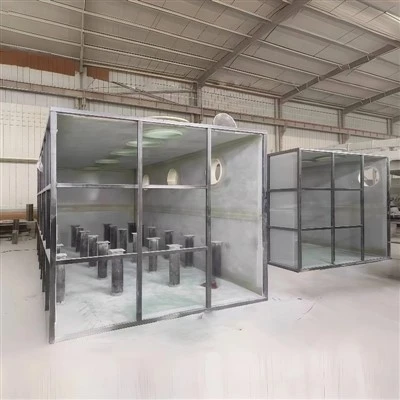
An FRP Electrolytic Cell is built with glass-fiber reinforcement and a corrosion-resistant resin matrix, using winding or hand-lay-up methods according to vessel geometry and production requirements. The internal surface is formed as a continuous chemical barrier, while external stiffening and connection areas are arranged around the loading and piping layout. Inlet, outlet, drain, overflow, circulation, and instrument openings can be positioned to suit the process drawing. After forming and curing, the vessel can be checked for sealing and liquid retention before delivery. This construction approach focuses on containment integrity, repeatable operation, and practical integration with process equipment.
Product Parameters
|
Parameter |
Specification |
|
Overall Size |
1000 × 800 × 1000 mm to 5000 × 2000 × 3000 mm |
|
Wall Thickness |
8–20 mm |
|
Working Temperature |
50–120°C |
|
Working Pressure |
0.1–0.3 MPa |
|
Compressive Strength |
≥30 MPa |
|
Tensile Strength |
≥80 MPa |
|
Compatible Media |
Sulfuric acid, hydrochloric acid, electroplating solution |
|
Resin Options |
Epoxy resin or vinyl ester resin |
Product Advantages
A corrosion-resistant inner layer separates process liquid from the structural reinforcement. External ribs support the tank body without adding unnecessary internal obstructions. Connection positions can be customized around pumps, circulation lines, drains, and instruments. The FRP Electrolytic Cell can therefore be configured around a defined process layout while keeping inspection and cleaning points accessible.
Main Applications
Typical applications include electroplating baths, electrolytic reaction vessels, metal-surface treatment lines, chemical processing tanks, and corrosive-liquid handling in metallurgical or pharmaceutical workshops. The same construction approach can also be used where a rectangular process vessel must connect with circulation, drainage, and dosing equipment. The FRP Electrolytic Cell can be arranged for process lines that require controlled electrolyte storage, circulation, and drainage.


FAQ
Q: What information is needed before confirming the tank layout?
A: Provide the process drawing, required working volume, installation space, inlet and outlet positions, drainage arrangement, and any instrument openings. This information is used to confirm the vessel geometry and connection locations. For an FRP Electrolytic Cell, the process medium, operating temperature, working volume, and connection layout should be confirmed before production.
Q: How is the internal surface prepared for corrosive service?
A: The inner surface is formed with a corrosion-resistant barrier based on the selected material system. The final configuration should be matched to the actual process liquid and operating conditions before production.
Q: What checks can be completed before delivery?
A: Dimensional checks, connection-position checks, surface inspection, and liquid-retention or leakage checks can be included according to the agreed inspection plan and project requirements.
Hot Tags: frp electrolytic cell, China frp electrolytic cell manufacturers, suppliers, factory, 48 x 72 fiberglass shower pan, Epoxy Resin Doctor Blade, fiberglass structural profiles, frp centrifugal blower, Frp Fiber Reinforced Bar, Frp Pultruded Sections